Most VA models end at placement. Once the assistant is assigned, everything else — onboarding, workflows, quality control, performance tracking — lands back on the client. The business owner becomes the operations manager behind the support they just hired to reduce their workload.
That's matched support. It provides access to a person. Managed support provides the systems that make that person effective.
"Businesses don't just need someone to complete tasks. They need a structured support system that creates consistency and accountability from day one."
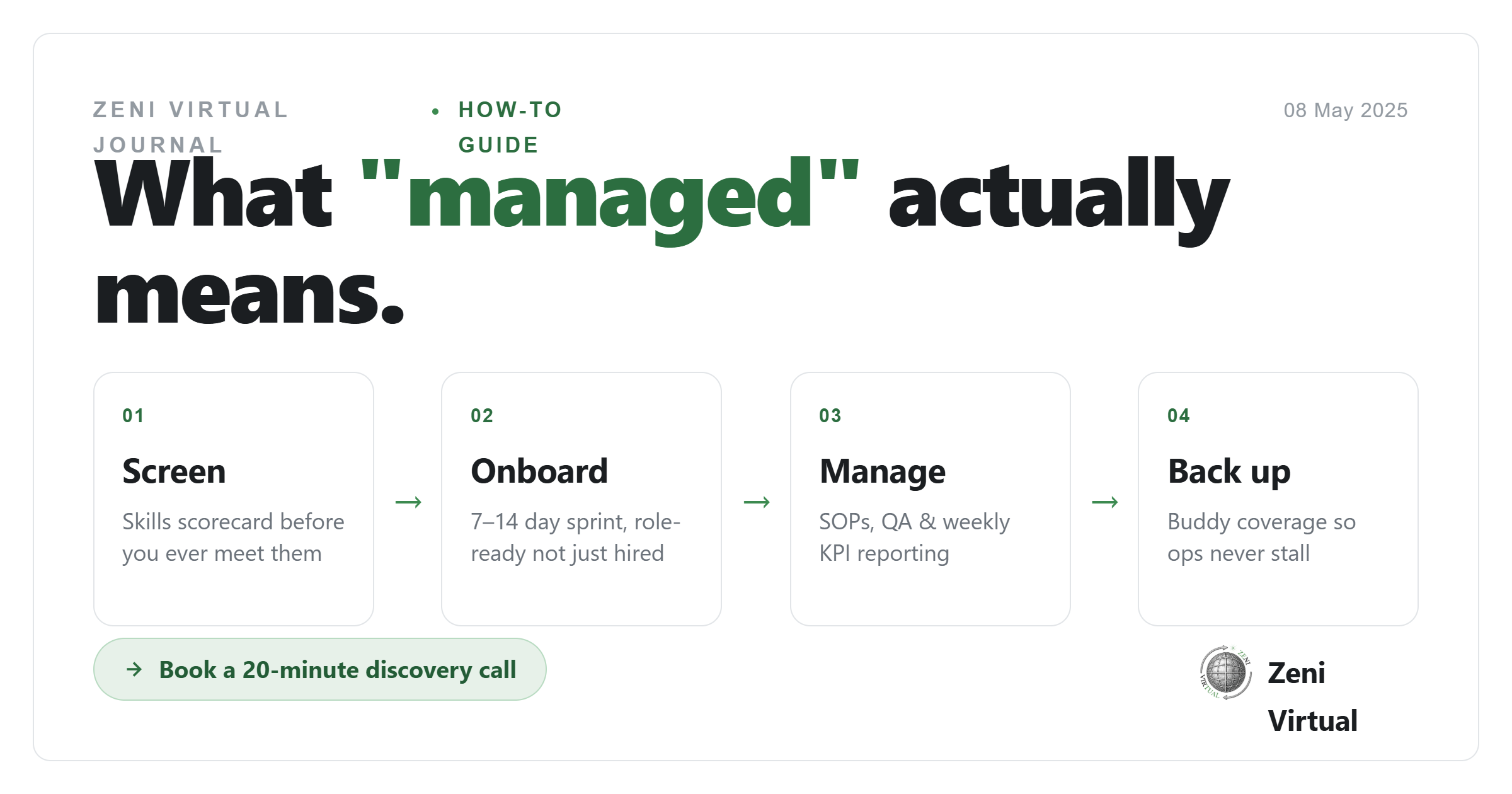
That belief is what the Zeni Virtual 4-phase framework was built on: Screen → Sprint → Deliver → Continue.
Phase 1 — Screening & Selection
Finding someone available isn't enough. An assistant can have years of experience and still struggle inside a real business environment if there's no alignment between the person, the workflow, and the operational expectations of the role.
That's why screening at Zeni Virtual goes beyond resumes and interviews. Every candidate is evaluated across five core categories:
1. Skills
Can they actually execute the tasks the role requires — inbox management, scheduling, reporting, client communication — not just list them on a CV?
2. Tools
Are they proficient in the platforms your business runs on? Google Workspace, ClickUp, Slack, CRM systems. Clients shouldn't spend weeks on basic tool training.
3. Process
Can they follow SOPs, maintain documentation habits, and operate within structured workflows consistently? Skill without process discipline creates instability.
4. Communication
Written clarity, responsiveness, proactive updates, and escalation awareness — because businesses need visibility, not just completed tasks.
5. Values & Reliability
Accountability under deadlines, confidentiality, ownership mentality, and adaptability. Delegation only works when trust is built into the foundation.
"Years of experience predicts almost nothing. Execution quality, communication consistency, and process alignment predict everything."
Candidates also complete structured assessments that simulate real operational tasks — because how someone performs in a task tells you far more than how they describe themselves in an interview.
Phase 2 — The Onboarding Sprint (Days 1–14)
Most delegation failures aren't a talent problem — they're an onboarding problem. Scattered instructions, unclear expectations, and no structured integration leave assistants learning through trial and error while founders keep stepping back in to fix things.
The Zeni Virtual onboarding sprint replaces that chaos with a guided 14-day process built around three stages:
Days 1–2: Access, Alignment & Setup
Systems access, communication channels, SOP introduction, escalation procedures, and task ownership boundaries are all established upfront. Ambiguity at the start becomes recurring problems later — so we remove it early.
Days 3–7: Shadowing & Guided Execution
The assistant observes live workflows, reviews completed examples, and practises tasks with structured feedback. This builds real workflow understanding before independent execution begins — and gives both sides early visibility into readiness.
Days 8–14: Independent Execution & Performance Validation
Recurring responsibilities are handled directly. Deliverables are reviewed against standards. Communication patterns are evaluated. Any workflow gaps are identified and corrected before they become habits.
A QA review is built into the sprint — not added after problems appear. Initial work is assessed for accuracy, workflow adherence, and documentation standards, creating an early feedback loop that improves execution before the assistant is fully embedded in the client's operations.
"Structured onboarding achieves stronger operational readiness in 7–14 days than most businesses see after 6–8 weeks of unstructured onboarding."
Phase 3 — Active Delivery
Onboarding is the beginning, not the finish line. This is where most traditional VA arrangements start to unravel — follow-ups become inconsistent, workflows drift, accountability weakens, and the founder gradually gets pulled back in.
The Active Delivery phase keeps that from happening through three continuous systems:
Weekly KPI Reports
Every week, clients receive a structured report covering tasks completed, turnaround times, communication metrics, workflow progress, QA observations, and improvement recommendations. Not to generate paperwork — but to ensure delegation never becomes invisible.
Daily Task Tracking
Workflows are tracked inside structured systems daily, keeping priorities aligned, deadlines visible, and recurring responsibilities consistently monitored. No scattered messages. No guesswork about what's been done.
Ongoing QA Checks
Small workflow gaps, when ignored, become larger operational problems. Regular QA reviews catch inconsistencies early — and create continuous improvement opportunities that strengthen the system over time.
"Effective managed support means the client stays fully informed — without staying overwhelmed."
The goal isn't more meetings or more check-ins. It's systems that maintain visibility and accountability without requiring the founder to monitor every detail personally. Fewer follow-ups. Fewer surprises. Fewer interruptions.
Phase 4 — Continuity & Backup
The biggest hidden risk in delegation is building critical workflows around one person. When that person is unavailable — through illness, leave, or role changes — businesses without a continuity plan scramble to recover.
At Zeni Virtual, continuity isn't an afterthought. It's built into the model from the start.
Backup Coverage
Every active VA is paired with a designated backup who is familiar with the account's essential workflows. Operational knowledge is documented and accessible — not locked inside one person's memory. If someone needs to step away, critical work keeps moving.
When Your VA Is Unavailable
We review active priorities, ongoing projects, and pending deadlines immediately. The continuity plan is activated, coverage is arranged, and the client is informed proactively — before issues become disruptions, not after.
The Replacement Process
When a long-term replacement is needed, we don't just find another person. We run structured candidate evaluation, role-specific matching, and a documented workflow handover. Because SOPs and operational standards are already in place, the incoming assistant steps into an established system — not a blank slate. Less downtime. Less disruption.
"The true test of support isn't how it performs when everything runs smoothly. It's how operations continue when circumstances change."
Want to See How the Sprint Works for Your Business?
Book a free 20-minute discovery call and we'll walk you through exactly how we'd set up your support system.