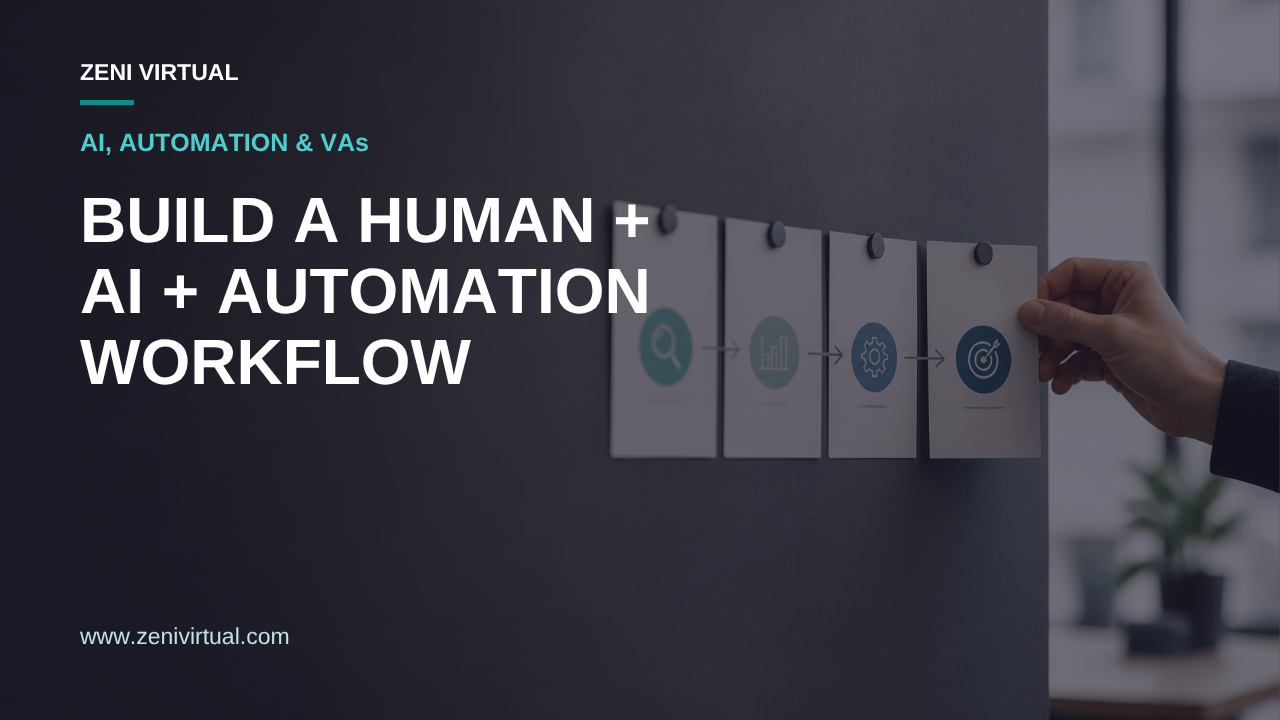
8. Build a Human + AI + Automation Workflow
The most useful approach isn't always choosing one. It can be designing a workflow where each component handles what it does best.
Example: Lead Management
Step 1 — Automation
A website form automatically sends a new lead into the CRM.
Step 2 — AI
AI categorizes the inquiry and summarizes the prospect's needs.
Step 3 — Virtual Assistant
The VA reviews the information, verifies the details, updates the CRM, and handles the appropriate follow-up.
Step 4 — Founder
The founder steps in when the opportunity requires a sales conversation, strategic decision, or high-level relationship management. This creates a system where technology reduces repetitive work while people remain responsible for judgment and relationships.
9. Create Clear Processes Before Adding Technology
Technology cannot fix an unclear process.
If you don't know:
Who owns the task
What the expected output is
When it should happen
What tools are involved
What happens when something goes wrong
Adding AI or automation may simply make the confusion happen faster or worsen.
Start with the process
Before implementing a new tool, document:
Trigger → Steps → Owner → Tools → Output → Quality check → Escalation
Then determine which parts should be:
Automated → AI-assisted → VA-owned → Founder-owned
This approach creates a much more intentional business operations system.
How Zeni Virtual Approaches the Human Side of Automation
At Zeni Virtual, we don't view technology and virtual assistants as mutually exclusive. A well-designed support system can combine people, processes, and technology.
Our objective is not to give a Virtual Assistant every task. It's to give the VA the right responsibilities, supported by clear SOPs, appropriate tools, measurable expectations, and quality controls.
For example, if a recurring process can be automated, that should reduce unnecessary manual work.
If AI can accelerate research or drafting, it can become part of the workflow.
And where a process requires human ownership, communication, judgment, or follow-through, a role-ready VA can manage that responsibility.
And that is where a managed virtual assistant model can be useful: the focus isn't simply on providing a person. It is on creating a structured system around the work.
A Simple Decision Matrix
If the task is... → Consider...
Repetitive and rule-based → Automation
Information-heavy and suitable for assisted processing → AI
Communication-heavy → VA
Requires judgment and relationship management → VA
Strategic or business-critical → Founder/leadership
A combination of repetitive + human steps → AI + Automation + VA
The important thing is that these categories aren't rigid. A single workflow can contain several types of work.
Conclusion
Don't Ask Which One Is Better—Ask Which One Fits the Work
AI, automation, and virtual assistants aren't alternatives. They solve different parts of the operational problem.
Automation can handle predictable workflows.
AI can help process and generate information.
Virtual assistants or simple VAs can provide human ownership, communication, judgment, and follow-through.
And founders should remain focused on the decisions and relationships that genuinely require their involvement.
Your goal should be to build an operating system where technology handles what technology does well, people handle what requires people, and founders have more capacity for the work only they can do.
Before investing in another tool or hiring another person, check your recurring tasks and ask:
Does this need automation, AI assistance, human ownership, or founder involvement?
That simple question can reveal opportunities to reduce repetitive work, improve efficiency, and build a more scalable operation.
So, are you ready to Build a Smarter Support System?
If you're unsure which tasks to automate, give AI to assist, delegate to a virtual assistant, or keep as founder-owned, Zeni Virtual can help you work through the operational side of that decision.
Our managed virtual assistant model combines role-ready talent, structured onboarding, SOPs, quality assurance, performance reporting, and backup coverage.
Has recurring work eaten into your team's time? Talk 📞 to Zeni Virtual about which responsibilities you can delegate and how to build a support system around them.
